
The short answer
Sialkot is a strong place to source sportswear, streetwear, team and promo wear, if you verify the factory first.
- Define the product, spec, quantity, market and deadline.
- Find three to five factories that already make your product type.
- Verify identity, registration and address before you share designs or money.
- Check every certificate with the body that issued it.
- Compare quotes on landed cost, not on factory price.
- Approve a sample and agree an inspection plan in writing.
- Pay by traceable transfer to the company's own account, in stages.
- Plan shipping, duty and holiday closures early, and confirm each with an expert.
For a first order, allow about six weeks to three months from approved spec to stock in hand. Everything below is dated and sourced.
Who wrote this. Adriqa Enterprises is a manufacturer in Sialkot, so we have an interest in this topic. We wrote the guide so that you can check any factory, including ours, with the same questions. Where a fact comes from an outside source, we name the source and the date.
01
What Sialkot is, and why buyers come here.
Sialkot is a city in Punjab, Pakistan, near the border with India. It is known worldwide as a centre for sports goods, and over time its stitching skills have grown into sportswear, streetwear, promo wear and activewear. Here are the facts that matter to a buyer, each with its source and date.
An export city
About 99% of what is made in Sialkot is exported.
Sialkot Chamber of Commerce, 2022 and 2026A large business body
More than 25,000 active firms are associated with the Sialkot Chamber of Commerce and Industry.
APP, September 2026Sports goods roots
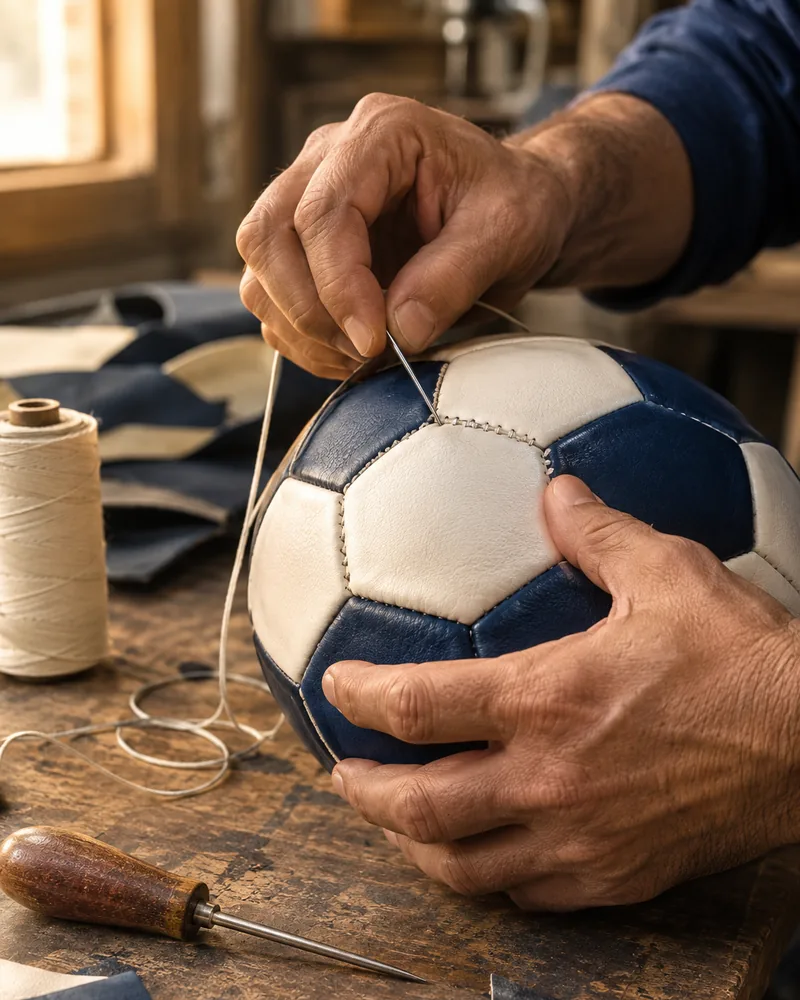
The sportswear sector grew out of sports goods, starting with inflatable balls exported from Sialkot.
TDAP sector profile, 2021Pakistan's sportswear exports
US$1.29 billion in 2020. The three biggest buyers were the USA, the UK and Germany.
TDAP, using Trademap data, 2021Built by exporters
The Sialkot Dry Port was founded in 1984 by 52 local exporters. The Sialkot International Airport was developed by the business community.
Sialkot Dry Port Trust; APP, 2026Many industries
Leather goods, sports goods, surgical instruments, gloves, textiles, sportswear, martial arts uniforms and musical instruments.
Sialkot Chamber of Commerce, 2022 and 2026Figures are as stated by the named source on the date shown. They change, so check current numbers with the Sialkot Chamber of Commerce and Industry or the Trade Development Authority of Pakistan (TDAP) before you quote them.
What this means for you: a buyer can find many experienced exporters in one place, support services such as customs clearance close to the factories, and a workforce with decades of stitching experience. It does not mean every factory is good. The verification steps exist because quality varies from one factory to the next, in Sialkot as everywhere.
02
Where Sialkot fits, and where to ask harder questions.
No sourcing region is right for every product. Use this table as a starting point, then ask each factory to show a finished example of your exact product type.
| Usually a good fit | Ask for proof first | |
|---|---|---|
| Products | Team kits, training wear, compression and base layers, tracksuits, T-shirts, hoodies, joggers, varsity jackets, polos, caps, workwear | Fully fashioned knitwear, tape-sealed waterproof shells, down-filled technical outerwear, tailoring, large-scale denim finishing |
| Order size | Small to medium runs, many styles, custom decoration | Very large identical programmes of one style: large integrated groups may suit better |
| Fabric | Stock or imported fabric with a known specification | Custom-woven or custom-knit fabric: longer lead times, ask who makes it |
| Speed | Fast sampling when you give a clear spec | New technical development with no spec to start from |
| Decoration | Embroidery, screen printing, sublimation and heat transfer | Specialised finishes such as laser work or special coatings |
Know where the fabric comes from
A TDAP profile of Sialkot's sportswear sector reported that raw materials and fabrics are largely imported, and that dyeing was done outside Sialkot. This may have changed, and it differs by factory. Ask where your fabric is made and dyed, because it affects lead time, colour matching and, for some markets, duty eligibility.
Match the factory to your order
Large integrated groups are built for very large identical programmes. Smaller specialist makers are built for variety, quicker sampling and small to medium runs. Neither is better; choose the one that fits your quantity and product. Adriqa works in the second way, across sportswear, streetwear, promo wear and activewear.
03
From first search to shipment: ten steps.
Skipping a step rarely saves time. It usually moves the problem to a more expensive moment. This is the order that works, with a link to the detail for each step.
- 01
Write your brief
One page: the product, the target customer, the spec (fabric, weight, colours, sizes), decoration, quantity per style and colour, the market you sell in and the date you need stock. A clear brief gets comparable quotes. See the tech pack checklist.
- Decide your must-haves and your flexible points.
- Choose a target landed cost, not only a factory price.
- 02
Find candidates
Use sources you can check: referrals from other brands, the Sialkot Chamber of Commerce and Industry, TDAP and its trade exhibitions, and focused searches for your product type. Shortlist three to five factories.
- Look for factories that already make your product type.
- Note whether each is a manufacturer, a trading company or an agent.
- 03
Make first contact
Send the same short message to each, with your brief. Watch how they reply: speed, clarity and whether they ask good questions about your product and market.
- Vague answers and flattery with no questions are a warning sign.
- Ask for finished examples of your product type.
- 04
Verify identity and legality
Before you share artwork or money, run the eight identity checks: registration, tax numbers, chamber membership, address, live video, bank account name, references and capacity.
- Check each document with the body that issued it.
- Keep copies of what you received.
- 05
Check certificates and audits
Ask which certificates the factory holds and which your customers need. Use the certificate decoder to see what each one proves and how to verify it.
- Match the name, address, scope and dates.
- Read audit findings, not only the certificate.
- 06
Request and compare quotes
Send every factory the same quote request. Put each quote into the landed-cost calculator, then score the factories on the scorecard.
- Ask each to list what the price includes.
- Ask for FOB and DDP quotes so you can compare.
- 07
Approve samples
Make a first sample, correct it, then approve a pre-production sample. Wash it, wear it, measure it and check colour in daylight. Keep the approved sample as the standard for bulk. See samples and inspection.
- Give feedback in writing, with photos and measurements.
- Do not approve production until the sample is right.
- 08
Agree the order and payment
Put the spec, quantity, price, terms, delivery date, inspection plan and payment schedule into one purchase order that both sides sign. See payment and the order.
- Pay by traceable transfer to the company account.
- Tie payments to milestones.
- 09
Monitor and inspect
Ask for progress photos. Inspect before production, during production and before shipment. Pay the balance only after the final inspection passes. See inspection and AQL.
- Agree AQL and the inspection method in writing.
- Book the inspection before the goods are packed.
- 10
Ship, clear customs and reorder
Confirm the route, Incoterm and documents with your forwarder. When stock lands, check it against the approved sample and note what sells by size and colour, so the reorder is faster. See shipping and customs.
- Ask your broker to check the product code and origin.
- Reorder early; repeat orders are quicker.
04
Verify the factory before you trust it.
Photos and websites can be copied. Verification means checking facts with a source that is not the supplier. Start by understanding who you are really dealing with.
Factory, trading company or sourcing agent?
| Manufacturer | Trading company | Sourcing agent | |
|---|---|---|---|
| Who makes it | Its own machines and staff | Other factories it buys from | Factories it introduces you to |
| Who you contract with | The factory | The trader | Usually the factory, with the agent as a go-between |
| Quality control | Direct, on its own floor | Indirect, through the supplier | On your behalf, if you pay for it |
| Cost | Factory price | Factory price plus margin | Factory price plus a fee or commission |
| Good for | Repeat orders and tight control | Mixed, small or varied orders | Buyers new to the country |
None of the three is wrong. The problem is only when a trader or agent pretends to be the factory. Ask directly, and ask for proof.
Eight identity checks
- Company registration. Ask for the incorporation or firm registration certificate. For a company in Pakistan, the registering body is the Securities and Exchange Commission of Pakistan (SECP); check the name and number with it.
- Tax registration. Ask for the National Tax Number (NTN) and, where applicable, the sales tax registration. The name must match the registration.
- Chamber membership. Ask for the Sialkot Chamber of Commerce and Industry membership number and confirm it with the chamber if you are unsure.
- Address. The address on the registration, invoices, website and bank letter must be the same. Find it on a map.
- Live video walk-through. Ask for a live call through the cutting room, sewing floor and finishing area, and ask them to show something you choose on the day, such as a sheet with today's date and your name.
- Bank account. The account name must be the registered company name. Ask for a bank letter. Never pay a personal account.
- Past work and references. Ask for finished examples of your product type and, where possible, to speak to a current customer.
- Capacity facts. Ask for machine counts and types, staff numbers and daily output for your product, then compare with what you saw on video.
Good signs
- Clear written answers and a detailed quote
- Documents that match each other
- Willing to do a live video on request
- Asks about your customer and market
- Sample before production, always
Warning signs
- Prices with no spec
- Reluctant to show the floor on live video
- Bank account in a personal or different name
- Pressure to pay everything up front
- Certificates with mismatched names or dates
For the questions to ask about quality, samples and terms, see the twelve vetting questions in Guide 01.
05
Certificate decoder: what each one proves.
A certificate is evidence, not a guarantee. Each one covers a specific thing: a quality system, a workplace, a material or a product. Match the certificate to the question you need answered.
| Name | What it is | What it does not show | How to verify |
|---|---|---|---|
| ISO 9001 | A standard for a quality management system, certified by an independent body. | That your garments will be defect-free. | Check the certification body and ask it to confirm the number and scope. |
| WRAP | Worldwide Responsible Accredited Production: certifies that a facility follows set workplace principles. | Product quality or fabric safety. | Ask for the certificate with the facility name and expiry, and confirm with WRAP. |
| SA8000 | A social accountability standard for workplaces, certified by accredited bodies. | Product quality or material safety. | Ask the certification body, and check the issuer is accredited. |
| amfori BSCI | A social compliance system used by amfori member companies; audit results are shared with members. | That you can see the report unless you are a member or the factory shares it. | Ask the factory to share the audit report and its date. |
| Sedex and SMETA | Sedex is a platform for sharing ethical trade data. SMETA is an audit method many members use. | It is not a certificate, and a report is only as current as its date. | Ask for the SMETA report and corrective action plan, and check the date. |
| OEKO-TEX STANDARD 100 | Tests textile products and materials for harmful substances. | Working conditions, or that every garment in your order was tested. | Use the online Label Check on the OEKO-TEX website with the certificate number. |
| GOTS | The Global Organic Textile Standard: organic fibres plus processing and social criteria, with a certified supply chain. | That a non-certified product in the same factory is organic. | Search the public GOTS database for the supplier and scope. |
Five checks for any certificate
- Name and address. They must match the exact factory you will use, not a group company or a supplier.
- Scope. It must cover your product type and process, such as cut-and-sew or printing.
- Dates. It must be valid for the time of your production, not expired.
- Issuer. It must come from an independent body, not the factory.
- Confirmation. The issuer or its public database must confirm it.

A mill's certificate does not cover the garment factory, and the reverse is also true. Adriqa sends copies of its certificates and audits on request, each with its number and dates.
06
Duties, origin and labels: what to check for your market.
Rates and rules change, and they depend on your country, the product code (the HS code), the origin and any trade preference. Rather than quote figures that may be out of date, this section shows you where to check them.
European Union
- Look up the duty for your product code with Pakistan as origin in the European Commission's Access2Markets tool.
- Pakistan has had GSP+ access to the EU. Business Recorder reported in July 2026 that Regulation (EU) 2026/1395 carries the scheme from 2027 to 2036 and that Pakistan's current arrangement runs to 31 December 2028; renewal needs reapplication. Confirm the status when you order.
- Preferential duty needs proof of origin. Ask the factory how it provides it.
- Labels: fibre composition and, under the General Product Safety Regulation, manufacturer or importer details. See the labels guide.
United Kingdom
- Use the UK Trade Tariff on gov.uk to find the commodity code and the rate for goods from Pakistan.
- The UK runs its own preference scheme for developing countries. Check which terms apply to Pakistan and its rules of origin.
- Import VAT and the customs declaration are handled by the importer or its forwarder.
- Labels: fibre content in English under the UK textile regulations. See the labels guide.
United States
- Use the Harmonized Tariff Schedule (USITC) to find the code and the duty.
- Rates and any additional duties change often. Confirm them on the day you place the order.
- Duty is generally charged on the price paid for the goods, without international freight and insurance. Confirm with your broker.
- Labels: fibre content, country of origin, the responsible company name or RN, and care instructions. See the labels guide.
Why fabric origin matters
Preferential duty depends on the origin of the finished product. For garments, the rules can depend on where the fabric, and sometimes the yarn, was made. Because fabrics for Sialkot sportswear have been reported as largely imported (TDAP, 2021), ask the factory early: where is my fabric made, and how will you prove the origin of the finished garment?
Not legal or customs advice
This section is general information. Confirm duty, origin rules and labels with your customs broker or a trade adviser before you commit to an order.
07
Landed-cost calculator: compare quotes on what you will really pay.
Landed cost is the total you pay to get goods to your door: product cost, freight, insurance, duty, import taxes, customs and port fees, and delivery. Enter the numbers from each quote and from your forwarder. The calculator runs in your browser and does not send anything anywhere.
Rules differ by country. The tax base and what can be reclaimed vary, so confirm with your broker or accountant. Adriqa does not publish prices; the numbers here are only the ones you type in.
08
Request quotes you can compare, then score the factories.
If every factory gets a different brief, you cannot compare the answers. Send the same request to each, then score the replies side by side.
Copy-ready quote request
Subject: Quote request: [product], [quantity] pieces, [market]

Hello [factory name],

We are looking for a manufacturer for: [product type and short description].

1. Style and spec: [attach tech pack, sketch or reference photo]. Fabric: [fibre, weight, finish]. Colours: [list]. Sizes and split: [quantity per size].
2. Decoration: [method, size, positions]. Artwork attached as vector files.
3. Labels and packing: [brand label, care and composition label for (country), hang tags, polybags, carton marking].
4. Quantity: [per style and colour], with possible reorders.
5. Destination and terms: [country and port]. Please quote FOB [port] and DDP.
6. Deadline: [date the stock must be at your warehouse].

Please include in your quote: the spec the price is based on, price per piece at each quantity step, minimum per style, colour and decoration, sample cost and time (and whether it is credited to the order), production lead time after sample approval, packing details, payment terms and how long the quote is valid.

Please also send: your company registration and tax numbers, copies of current certificates and audit reports with expiry dates, and photos or a live video of the floor that makes this product.

Thank you,
[Name, company, WhatsApp]
What a complete quote includes
- The spec the price is based on (fabric, weight, decoration, labels, packing)
- Price per piece at each quantity step, and the terms (FOB, DDP)
- Minimum per style, per colour and per decoration
- Sample cost, sample time and whether the cost is credited
- Production lead time after sample approval
- Payment terms and how long the quote is valid
Factory scorecard
Score each criterion from 1 (weak) to 5 (strong) for up to three factories, then add them up. Give extra weight to the criteria that matter most for your product.
| Criterion | Factory A | Factory B | Factory C |
|---|---|---|---|
| Makes my product type (shown with examples) | |||
| Identity and documents verified | |||
| Certificates checked with the issuer | |||
| Sample quality | |||
| Clarity and speed of communication | |||
| Quote completeness | |||
| Realistic lead time | |||
| Fair payment terms | |||
| Knows labelling and market rules | |||
| Open to inspection and audits | |||
| Total |
09
Samples, inspection and AQL: how to protect the order.
The approved sample says what you want. Inspection checks that the bulk order matches it. Agree both in writing before production starts.
Four samples, four jobs
First sample
Checks the design, fit, fabric and decoration. Expect corrections.
Fit or revised sample
Confirms your corrections on a real person and after a wash.
Pre-production sample
Made from the bulk fabric and trims. This becomes the standard for the whole order.
Shipment sample
A piece from the finished order, sent before or with the goods, to confirm the match.
Three inspections
Fabric, trims and the pre-production sample are checked before cutting starts.
Pieces are checked while about a fifth to half of the order is sewn, so problems are fixed early.
When the order is packed. Pay the balance only after it passes.
What AQL means
AQL, the Acceptable Quality Limit, is the number of defects you accept in a random sample from your order. It is based on the ISO 2859-1 sampling tables: the bigger the order, the bigger the sample. Defects are usually grouped as critical (unsafe), major (the customer would return it) and minor (small flaws). Many apparel buyers use about 2.5 for major defects and 4.0 for minor ones, with none allowed for critical ones. Agree your own levels in writing before production.
Ask the inspector to check
- Measurements against your size chart
- Stitching, seams and finishing
- Print and embroidery placement and quality
- Colour against the approved sample
- Labels, hang tags and packing
- Carton marks and counts
Ask a lab to test, if it matters
- Shrinkage and colourfastness after washing
- Seam strength and fabric weight
- Restricted substances for your market
- Any claim you will make about the fabric
Tests are quoted per order and confirmed in writing. Ask for the lab's name and report.
10
Pay safely, and put everything in one purchase order.
Most sourcing problems that cost real money are payment problems. The rules are simple: pay the right account, in stages, against a document, and keep the final payment until after inspection.
Do
- Pay by traceable bank transfer to an account in the registered company name.
- Pay against a written pro-forma invoice that matches the purchase order.
- Split payments: a deposit to start, the balance after final inspection and before shipment.
- Confirm the bank details by a separate channel before the first payment.
- Keep every message, invoice and receipt.
Do not
- Pay a personal account, or an account in a different name.
- Pay the full amount before the sample is approved.
- Change bank details because of an email alone.
- Accept a verbal agreement on specs, dates or payment.
- Release the balance before the inspection report.
Letters of credit and escrow services add protection on larger orders, at a cost and with more paperwork. Ask your bank or a trade adviser which suits your order. This is general information, not financial or legal advice.
What goes in the purchase order
- The spec and the reference to the approved sample
- Quantity by style, colour and size
- Price per piece and the Incoterm
- Delivery date and what happens if it is missed
- Packing, labels and carton marking
- Inspection rights, AQL and who pays for re-inspection
- The payment schedule and the bank details
- Confidentiality and who owns the artwork and patterns
- How disagreements are handled, and which law applies
11
Shipping from Sialkot: routes, Incoterms and customs.
Your forwarder confirms the exact route. This shows the usual shape of each one.
Sea
- Factory, Sialkot
- Sialkot Dry Port: customs clearance
- Karachi sea port
- Ocean freight
- Your port and customs
- Your warehouse
Air
- Factory, Sialkot
- Sialkot or Lahore airport
- Air freight
- Your airport and customs
- Your warehouse
Schematic only, not to scale. The Sialkot Dry Port, in Sambrial, is run by the Sialkot Dry Port Trust, which states that it offers customs clearance round the clock, sealed GPS-tracked bonded vehicles, and terminal offices in Karachi, Lahore and Islamabad. The Sialkot International Airport was developed by the local business community to address exporters' and buyers' travel and logistics.
Door to door, depending on routing and customs.
Door to door, depending on the destination port and customs.

Incoterms, in plain words
| Term | Meaning | Watch for |
|---|---|---|
| EXW | Ex Works: you collect from the factory and pay all transport. | You handle export clearance and inland transport in Pakistan. |
| FOB | Free on Board: the seller delivers to the ship at the port of export. You pay from there. | Name the port, for example FOB Karachi. Usually the clearest for first-time importers. |
| CIF | Cost, Insurance and Freight: the seller pays freight and insurance to your port. | You still pay duty and handle customs. The seller's insurance may be minimum cover. |
| DDP | Delivered Duty Paid: the seller delivers to you with duty paid. | Simplest, but check who is the importer of record and whether the quote includes everything. |
Documents for customs
- Commercial invoice and packing list
- Bill of lading (sea) or air waybill (air)
- Proof of origin, if you claim a trade preference
- Labels and any test reports your market requires
- Your importer registration number, where your country needs one
12
Plan the calendar: work backwards from the date you need stock.
Start from the date the goods must be in your warehouse and subtract each stage. These mid-range values are for illustration, not a promise. Your factory confirms real dates in writing.
| Stage | Sea route | Air route |
|---|---|---|
| Samples | 2 weeks | 2 weeks |
| Your approval and courier | 1 week | 1 week |
| Production | 4 weeks | 4 weeks |
| Shipping | 5 weeks | 1 week |
| Buffer | 2 weeks | 2 weeks |
| Total | 14 weeks | 10 weeks |
See typical ranges for your product, quantity and country in the lead-time planner.
Things to plan for in Pakistan
Eid al-Fitr and Eid al-Adha
Factories typically close for several days around each. The dates move about eleven days earlier each year. Ask for the closing dates when you order.
Ramadan
Working patterns can change during the month. Ask how it affects your production and delivery dates.
Monsoon season
Heavy rain, typically from July to September, can delay road transport and port handling. Add buffer for shipments in this period.
Peak seasons
Factories fill up before the main selling seasons in your market. Book capacity early and confirm the slot in writing.
Imported fabric and trims
If your fabric or trims come from China, ask whether Lunar New Year closures could delay them.
Power and logistics
Ask the factory how it manages power cuts and what happens to your dates if there is a disruption.
13
Visiting Sialkot, or auditing from home.
A visit shows what documents cannot: how the floor looks, how people work and how the factory handles a problem. If you cannot go, there are good alternatives.
Before you go
Check your government's current travel advice and Pakistan's official visa rules. Ask the factory for a written itinerary, and plan to arrive through Sialkot or Lahore.
On the floor
Look at the cutting room, the sewing lines, finishing and quality checks, the sample room, storage, fire exits and working conditions. Ask to see your product type in production.
Remote options
Use a live video walk-through, a third-party audit or a local inspector. Start with a small trial order before a large one.
Plan for two or three factory visits per day at most, and keep one day free for sample review and a meeting with your forwarder.
14
Ten sourcing mistakes, and how to avoid each one.
- Paying a deposit to an unverified account. Verify the company and the account name first.
- Judging a factory by photos or a website. Both can be copied. Ask for a live video.
- Comparing factory prices, not landed cost. Freight, duty and fees can reverse the order.
- Ignoring fabric origin. It can decide whether a trade preference applies.
- No written inspection plan. Agree AQL and the final inspection before production.
- Planning with no holiday buffer. Allow for Eid closures and monsoon delays.
- Accepting a certificate without checking it. Name, scope, dates and issuer must all match.
- Sending designs to many factories with no confidentiality. Agree confidentiality before you share artwork.
- Relying on one supplier for everything. Keep a tested second source for key products.
- Skipping a small trial order. A trial order finds problems cheaply.
15
Glossary for sourcing from Pakistan.
- HS code
- The product code used by customs worldwide. It decides the duty rate.
- Landed cost
- Everything you pay to get goods to your door.
- FOB
- Free on Board: the seller delivers to the ship at the export port.
- CIF
- Cost, Insurance and Freight to your port.
- EXW
- Ex Works: you collect from the factory.
- DDP
- Delivered Duty Paid: the seller delivers to you with duty paid.
- AQL
- Acceptable Quality Limit: how many defects you accept in a random sample.
- Final random inspection
- A check of a random sample of the packed order, before you pay the balance.
- Pre-production sample
- A sample made from the bulk fabric and trims. It sets the standard for the order.
- Pro-forma invoice
- A seller's draft invoice you pay against.
- Packing list
- A list of what is in each carton.
- Bill of lading
- The sea transport document that also proves ownership of the goods.
- Air waybill
- The air transport document. It is a receipt, not a title to the goods.
- GSP+
- The EU preference scheme that lowers duty for eligible developing countries, on conditions.
- NTN
- National Tax Number: a Pakistani taxpayer registration.
- SECP
- Securities and Exchange Commission of Pakistan: registers companies.
- TDAP
- Trade Development Authority of Pakistan: the national export promotion body.
- Lead time
- The time from approved order or sample to goods ready to ship.
16
Questions buyers ask, by topic (24 answers).
Short, direct answers to the questions buyers ask most about sourcing apparel from Sialkot. Jump to a topic, or read them in order.
About Sialkot as a sourcing city
What Sialkot makes, who it suits and how it compares with other places.
Why source clothing from Sialkot, Pakistan?
Buyers choose Sialkot because it is an export-focused manufacturing city with a long record in sports goods and sportswear, a skilled stitching workforce and exporters who are used to international buyers. About 99% of what is made in Sialkot is exported, according to its Chamber of Commerce. As with any city, quality depends on the individual factory, so verify the factory before you order.
What clothing is made in Sialkot?
Sialkot makers produce sportswear and team kits, training wear, compression and base layers, tracksuits, T-shirts, hoodies, joggers, jackets, polo shirts, caps, workwear and promotional wear, plus martial arts uniforms and gloves. Adriqa covers four lines from here: Perform (sportswear), Urban (streetwear), Pro (promo wear and uniforms) and Flex (activewear).
Is Sialkot only known for sports goods?
No. Sports goods such as footballs, hockey sticks, cricket gear and boxing gloves made the city famous, but its firms also make leather goods, surgical instruments, gloves, textiles, sportswear, martial arts uniforms and musical instruments, according to the Sialkot Chamber of Commerce and Industry. Streetwear, promo wear and activewear are a natural extension of the same stitching skills.
Is Sialkot a good choice for small or first orders?
It can be. Many Sialkot makers work in small to medium runs with custom decoration, rather than only very large identical programmes. Minimums depend on the product, fabric and decoration, so ask each factory for its minimum per style, colour and decoration in writing. Read how minimums work.
Finding and verifying a manufacturer
How to find real factories and avoid traders posing as makers.
How do I find a genuine clothing manufacturer in Sialkot?
Start with sources that can be checked: referrals from other brands, the Sialkot Chamber of Commerce and Industry, the Trade Development Authority of Pakistan (TDAP) and its trade exhibitions, and direct searches for your product type. Shortlist three to five factories that already make your product, then run the same identity checks on each before you share designs or send money.
How can I tell a factory from a trading company?
Ask for a live video walk through the cutting room, sewing floor and finishing area, and ask the contact to show something specific you request on the day, such as a sheet with today's date. A factory can show its own machines, staff and your product type in production. A trading company or agent buys from factories and adds a margin, which is fine if it is honest about it. See the comparison table.
What documents should a Sialkot supplier be able to show?
A genuine exporter can usually show its company or firm registration, tax registration numbers, membership of a chamber of commerce, a bank letter in the company name, current certificates and audit reports with expiry dates, and photos or video of the floor that makes your product. Check each one with the body that issued it rather than trusting a PDF alone. The eight identity checks explain how.
Should I visit the factory before ordering?
A visit is the best check but not essential for a first order. If you cannot travel, use a live video walk-through, a third-party audit or a local inspector, and start with a small trial order. If you do visit, plan the trip around your product line, and check your own government's current travel advice first.
Certificates, audits and compliance
What each certificate proves, and how to check it is real.
Which certificates matter for clothing from Pakistan?
It depends on what you need to prove. ISO 9001 covers quality management, WRAP, SA8000, amfori BSCI and Sedex SMETA audits cover working conditions, OEKO-TEX STANDARD 100 tests products for harmful substances, and GOTS covers organic fibres. No single certificate covers everything, so ask which ones your customers or marketplaces require. The certificate decoder lists what each one does and does not show.
How do I check that a certificate is real?
Check five things: the name and address match the exact factory, the scope covers your product and process, the dates are valid, an independent body issued it, and the issuer confirms it. OEKO-TEX offers an online Label Check and GOTS publishes a public database of certified suppliers. For the rest, ask the issuing body to confirm the number. See the full checklist.
Does a certificate mean my garments will be good quality?
No. Most certificates describe a factory system, a workplace or a material, not the quality of your order. ISO 9001 shows documented processes, not defect-free garments. Protect your order with an approved sample, a written inspection plan and a final inspection before you pay the balance.
How do I check working conditions at a Sialkot factory?
Ask for recent social audit reports, such as WRAP, SA8000, amfori BSCI or Sedex SMETA, and read the findings and corrective actions, not only the certificate. Then check on site or through a third-party auditor: safety exits, working hours records, ventilation and how staff are treated. Adriqa sends copies of its certificates and audits on request.
Duties, origin and labels
How to check what you will pay at the border and what your labels need.
Do I pay import duty on clothing from Pakistan?
Usually yes, and the rate depends on your country, the product code, the origin and any trade preference. Do not rely on a single figure. Look up your product code with Pakistan as origin in the EU's Access2Markets tool, the UK Trade Tariff or the US Harmonized Tariff Schedule, and confirm with your customs broker on the day you order. The landed-cost calculator shows how duty fits into your total.
What is GSP+ and does it affect my order?
GSP+ is the European Union's trade preference scheme that gives eligible developing countries, including Pakistan, reduced or zero duty on many goods if they meet conditions. Business Recorder reported in July 2026 that a new regulation carries the scheme from 2027 to 2036, with Pakistan's current arrangement running to 31 December 2028 and renewal requiring reapplication. Confirm the current status before you order, because it can change.
Does imported fabric affect duty-free eligibility?
It can. Preferential duty depends on the origin of the finished product, and for garments the rules can depend on where the fabric, and sometimes the yarn, was made. A TDAP profile of Sialkot's sportswear sector reported that raw materials and fabrics are largely imported. Ask the factory where your fabric comes from and how it will prove origin, and check the rules of origin for your market.
What labels does clothing made in Pakistan need?
The labels depend on where you sell, not where the garment is made. The EU and UK need fibre composition, and the EU also needs manufacturer or importer details. The US needs fibre content, country of origin ("Made in Pakistan"), the responsible company name or RN number and permanent care instructions. See the full labels guide for the EU, UK and US.
Quotes, samples, inspection and payment
How to compare offers fairly and protect your money and your order.
What is landed cost and why should I compare it?
Landed cost is the total you pay to get goods to your door: product cost, freight, insurance, duty, import taxes, customs and port fees, and delivery. Two quotes that look different at factory level can end up close, or reversed, once these are added. Compare factories on landed cost with the calculator, and ask each to quote on the same spec and the same terms.
How should I pay a Pakistani supplier safely?
Pay by traceable bank transfer to an account in the registered company's name, against a written pro-forma invoice, and split the payment: a deposit to start and the balance only after final inspection and before shipment. Never pay a personal account or an account in another name without checking. Letters of credit and escrow add protection for larger orders. This is general information, not financial advice.
How many samples should I order?
Plan on at least two: a first sample to check fit, fabric and decoration, and a pre-production sample that matches what bulk will be. Order more if the design is new or complex. Keep one approved sample as the reference for the whole order. See the sample-to-bulk steps.
What is AQL and which level should I use?
AQL, the Acceptable Quality Limit, is the number of defects you accept in a random sample from your order, based on the ISO 2859-1 sampling tables. Many apparel buyers use about 2.5 for major defects and 4.0 for minor ones, but the right level depends on your product and customers. Agree it in writing before production and test it in a final random inspection.
Shipping, customs and timing
Routes, terms and how to plan around Pakistani holidays.
How long does shipping from Sialkot take?
Typical door-to-door times are about 4 to 10 days by air and about 3 to 8 weeks by sea, depending on the destination, routing and customs. Your forwarder should confirm current times for your order. Production comes first: for a first order, plan about six weeks to three months from approved spec to stock in hand. See the lead-time planner.
Which Incoterm should I choose when buying from Pakistan?
FOB (Free on Board) is the most common choice for new importers who use their own forwarder: the seller delivers to the ship at the port of export and you control freight from there. DDP (Delivered Duty Paid) is simplest but the seller then handles duty and customs in your country. Ask for both quotes so you can compare, and see the Incoterms table.
Which port or airport do goods leave from?
Sea cargo from Sialkot normally goes by road to a Pakistani sea port, usually Karachi, with customs clearance available at the Sialkot Dry Port in Sambrial, which has terminal offices in Karachi, Lahore and Islamabad. Air cargo goes through Sialkot or Lahore airport. Your forwarder will confirm the best route and the documents you need.
How early should I order to avoid Eid and holiday delays?
Order early enough to absorb a closure of several days around Eid al-Fitr and Eid al-Adha. Their dates move about eleven days earlier each year, so ask your factory for its closing dates when you place the order. Add a buffer of about two weeks to your plan. If your fabric or trims come from China, ask about Lunar New Year closures too. See the calendar guide.
Made in Sialkot, Pakistan
Source from Sialkot with Adriqa.
Adriqa Enterprises is a private label apparel manufacturer in Sialkot. We make for brands, teams and businesses in Europe, the UK and North America across four specialist lines and 240 ready styles. Send us your brief and we will answer with questions or a written quote, and we are happy to be checked against every step in this guide.
Sources
- Trade Development Authority of Pakistan: Sportswear sector profile (2021)
- The Express Tribune: Sialkot contributes $3b to exchequer: SCCI (8 August 2022)
- Associated Press of Pakistan: Sialkot, Pakistan's export powerhouse (September 2026)
- Sialkot Dry Port Trust: About us
- Business Recorder: Pakistan's exports to EU have two years, and govt has one job: implementation (July 2026)
- European Commission: Access2Markets
- GOV.UK: Trade Tariff
- US International Trade Commission: Harmonized Tariff Schedule
- OEKO-TEX: STANDARD 100
- Global Organic Textile Standard (GOTS)
- WRAP: Worldwide Responsible Accredited Production
- Sedex
- Securities and Exchange Commission of Pakistan
Last reviewed on 7 November 2026. Duty rules, trade preferences and travel conditions change, so confirm each with the official body before you act. This guide is general information, not legal, customs or financial advice. If you see something out of date, email us and we will check it.